In a previous blog post, I looked at how the top 10 JMP blog posts from 2011 held up over time and hinted toward the discrepancy between WordPress counts and Google Analytics. While I didn’t have historic WordPress counts for those blog posts, it's much easier for the posts released in 2014 since all started with view counts of zero -- much easier to make a direct comparison. I thought the Google Analytics Pageviews over the same period of time would presumably be highly correlated with the WordPress views. In particular, when the Top 10 JMP Blogs of 2014 via WordPress views were revealed last month, I expected the Google Analytics list should look the same. If the lists were identical, there wouldn’t be much point in writing up a blog entry. So without further ado, let’s take a look at the top 10 JMP blog posts of 2014 according to Google Analytics:
Determining chemical concentration with standard addition: An application of linear regression in JMP by Eric CaiStrengths and weaknesses of spreadsheets – part 2 by Charles Pirrello#OneLessPie chart on Pi Day by Xan GreggAn eggciting designed eggsperiment by Ryan LekivetzWhy spreadsheets can lead to error - part 1 by Charles PirrelloThe eggciting results of my designed eggsperiment by Ryan LekivetzTwo kinds of dot plots by Xan GreggHoliday book gift ideas for the analytically minded by Anne MilleyJMP Pro for linear mixed models - part 1 by Jian CaoWhat is an Alias Matrix? by Ryan LekivetzThe differences
Four of the top 10 are different. What’s also striking is that the blog post with the most WordPress views doesn’t even show up on the Google Analytics list (to be fair, it is No. 11), whereas the No. 2 post, according to Google Analytics, didn’t show up on the WordPress list.
If you read through how WordPress calculates views and how Google Analytics makes calculations, you would think these would be closer. However, taking a look at a scatterplot of WordPress vs. Google views for the JMP blogs from 2014 (top 10 via Google are bolded), we see that’s not really the case.
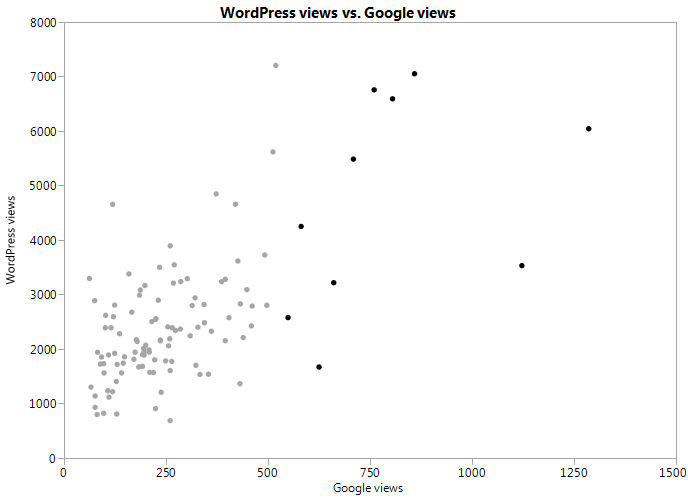
What’s even more alarming is the scale of the number of views. Over the course of the year, the total number of WordPress views are about nine times that of Google Analytics.
Any readers with experience between the discrepancies? How do your counts compare? Next time, I’ll take a further look at the data to see if any information can highlight some of these differences.
