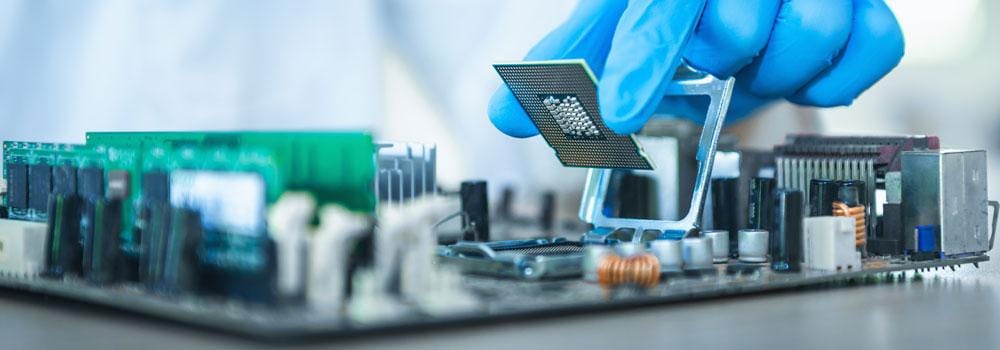
Semiconductor industry overview
A recent Deloitte study highlights that the semiconductor industry is entering a period of robust growth. The total size of the semiconductor industry is expected to reach an eye opening $600 billion in 2022, up 10% from 2021. Chip shortages are costing semiconductor companies and their customers an estimated $500 billion in 2021. Chips are becoming a critical component across all industries, defeating the near-term chip shortage and positioning for long-term growth will be challenging. Who’s going to make all these chips?
What problems do these JMP users have?
The production of semiconductors is complex because these chips can be used for many diverse and disparate purposes. Semiconductors can be used in products as complicated as computers and as simple as a child’s toy that makes noise when you press a button. Fundamentally, semiconductor companies are looking for ways to make their production process cheaper and more reliable.
How to make it cheaper?
The production of cheaper semiconductors is one problem that many JMP users experience. This comes from testing runs where companies are able to do things like use cheaper materials or make bigger runs of chips which drops the cost per unit. The issue with this process is that it comes with the possibility of a higher failure rate with the semiconductor chips.
How to make it more reliable?
Producing more reliable semiconductors is another problem that many JMP users have. Normally, whenever a new semiconductor is created there is a certain "acceptable failure rate". Chips that fall below this rate need to be thrown away, reducing the number of semiconductors that can be sold. To make the end-to-end process more reliable, a company should:
- Change their manufacturing process
- Make the testing process more robust
- Record all of the manufacturing and testing data
Making cheaper and more reliable semiconductors causes a company to generate an enormous amount of data. To overcome these problems, companies must track, evaluate, and analyze data. This must be done over time, in order to ensure that production is trending in the right direction. So how does one ensure that is happening?
What do they use JMP for?
JMP, with its statistical analysis tools, is able to store and analyze the testing data from many different runs or processes and track them over time.
How to make it cheaper
When companies are looking to save costs, they need JMP to:
- Ensure that their new materials are at-par or within acceptable margins of failure rates as the previous processes. This means that if there are extra failures, it does not end up costing more money due to the need of extra losses in sales.
- Ensure that with the bigger runs, that the extra failures are not an exponential increase. If they are, find the best fit line which allows for the highest net profit.
How to make it more reliable
When customers want to create a more consistent product, they need to:
- Ensure that the new manufacturing process is not costing more money than they are saving by throwing away less.
- Ensure that the new testing process is not slowing down the creation of semiconductors, thereby negating the cost benefits.
- Get a better picture of their current process to find out where problem areas reside. For example, they may find that certain machines have higher failure rates than others, which may mean maintenance is needed or a new machine is required.
The following is a real model that was produced by JMP. It shows the problem areas inside of a semiconductor chip where the chip itself is outside of “normal” manufacturing expectations and moving towards the limits of the physical tolerances.

All of this can easily be modeled once you have this large dataset inside a program like JMP.
Customer stories
Innovation in manufacturing begins with the right tools
Daeduck Electronics elevates its analytical capabilities to reduce costs and streamline production
JMP plays a key role in tasks such as waste reduction, yield improvement and process optimization. “There are tasks that I can now perform in 90% less analysis time using JMP, which means that I can do so much more in the same workday than before,” says Manager Lee SungSoo.
“When I first started using JMP, I found it was more powerful because it was designed from an engineer's perspective... JMP belongs to a higher class than other programs because it is designed to solve all kinds of problems experienced by engineers – it’s really convenient for engineers to use.”
“DOE offers a great deal for our engineers,” he says. “It’s a way for us to utilize our engineering resources and time more efficiently.” The JMP Custom Design platform in particular allows engineers to set constraints on the design space and identify which effects are necessary to estimate and which are desirable to estimate, if possible, given the number of runs. By using statistical analyses to be more precise and proactive, Daeduck is able to reduce the time and costs associated with on-site experimentation and other processes.
Mining big data propels increased product miniaturization
Engineers apply JMP and innovative thinking to create cutting-edge electronics
 “We use data analysis to prioritize challenges and tackle those for which we anticipate large improvement effects. By aggregating results in JMP, we’ve created an easy way to systematize operational evaluations across departments.”
— Osamu Shimoyae, Senior Manager, Production Innovation
"The appeal of JMP," says Shimoyae, "is that the data is searchable." JMP can process data in real time, reflecting users’ thought patterns and ideas. If you have a quandary, you can run it through JMP and have an answer straight away.
Acknowledgements
We would like to thank @PeterHersh, @MarkZwald, @HadleyMyers, and @HydeMiller for their expert insight and input.
Sources