Developer Tutorial: Using JMP Pro Generalized Regression to Better Understand Observational DataObservational data lends itself to analysis useful for large data sets, data that probably do not exhibit orthogonality and situations where we are interested in prediction rather than interpretation. The Generalized Regression platform is the place to build regression models for both designed experiments and observational data. Some things to keep in mind:
1) Penalized regression shows great promise for observational data.
2) Effect Heredity probably isn’t necessary.
3) Use a holdout set if you have enough data, otherwise the AICc.
See how to:
- Understand background principles related to estimation and the needs to consider:
- How far from the truth the estimates tend to be (Bias)
- How variable the estimates are (Variance)
- How bias and variance principles combined can be measured by Mean Square Error of an estimator
- Understand Penalized Regression techniques (Ridge, Lasso, Elastic Net, Adaptive Lasso, Double Lasso, Dantzig Selector)
- See how Effect Heredity is handled in JMP Pro
- Choose Grid Control options
- Use Forced Terms, Early Stopping and Informative Missing
Resources

Predictive Modeling and Machine LearningRe: Developer Tutorial: Using JMP Pro Generalized Regression to Better Understand Observational Data@H2OSUP so glad that you found the presentation to be useful! You are correct - if you have a missing value in one of your predictors, the default behavior is for genreg to ignore that entire row of data.
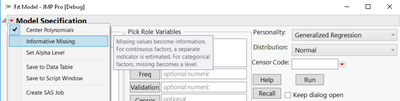
There is a way around this though, using the "Informative Missing" option in Fit Model. You can find it in the red triangle menu in the Fit Model model specification dialog (screenshot below). The short story is that this option uses mean imputation for the missing values and adds an indicator for missingness to your model. But for more detail, John Sall wrote a blog post about the Informative Missing option.
Re: Developer Tutorial: Using JMP Pro Generalized Regression to Better Understand Observational Data@clay_barker thank you for the presenting the tutorial last fall. I found your presentations very useful and well done. I have a question on how GENREG handles missing cells in a data set. If one cell is missing for an input, will GENREG exclude the entire row in the analysis? I am wondering if GENREG would include the row for models containing inputs that are not missing for a row if other inputs have missing values. Thanks, Mike.
