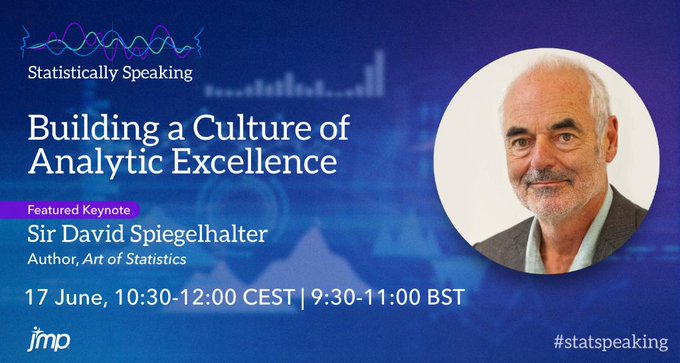
The benefits of a data-driven culture was the focus of today’s Statistically Speaking Europe event, Building a Culture of Analytic Excellence. The live streamed event attracted more than 700 registered attendees, with the on-demand event (soon to be available) promising to attract many more.
Today’s keynote address was delivered by thought leader, and former Discovery Europe Keynote Sir David Spiegelhalter. Immediately following the keynote, Spiegelhalter was joined by Salvador Santiago (BASF), Anders Reinhardt (Coloplast) and Paul Deen (ASM International) for a discussion on how successful companies use data to enhance their communication and decision making and to share best practices for building a culture of analytic excellence.
To help JMP sales team engage in more meaningful and productive post-event conversations with customers and prospects, we’ve created the following list of recommended resources to position now that the event has concluded. This list pulls appropriate assets from across our web site.

Sales Force Campaign Link (On Demand) Can be Found Here
Sales Force Campaign Link (Live Stream) Can be Found Here
The Art of Statistics, Book Chapter, Book Chapter
Very interesting chapter from keynote Sir David Spiegelhalter. In this excerpt, taken from the introduction, Spiegelhalter takes a forensic look at data surrounding the victims of the United Kingdom’s most prolific serial killer, Harold Shipman. A family doctor working in a suburb of Manchester, Shipman injected at least 215 mostly elderly female patients with lethal doses of morphine between 1975 and 1998. Spiegelhalter shows how a simple search for patterns reveals critical details surrounding the deaths and a general understanding of how Shipman went about committing his crimes. It’s an analysis that, if it had been done earlier, almost certainly would have saved lives.
In The Art of Statistics Spiegelhalter shows us how to extract knowledge from raw data, think critically (like a statistician) and explains why a basic grasp of statistical literacy is more important than ever if we hope to separate fact from fiction.
Questioning the Numbers of Everyday Life, Analytically Speaking
Anne Milley conducts this very interesting interview with Sir David Spiegelhalter as part of the Analytically Speaking program. Owning up to the judgments we make during the statistics process. Spiegelhalter talks about topics like quantifying bias, the difference between data visualization and infographics and how (and why) we should openly communicate uncertainty.
ASM Customer story
Panelist Paul Deen is featured in this customer success story. Deen talks about how ASM sees great results in regard to efficiency and effectiveness using JMP: “We have a much deeper understanding and are able to work much faster thanks to JMP (software)’s visual approach to statistically backed data analysis.”
Lead your organization to analytic excellence Statistically Speaking
In this Stat Speaking event Tom Lange reflects on his time as a Director of R&D at Procter & Gamble, sharing what he learned about organizational cultures of analytic excellence. Lange talks about the how we can all lead and shape decision making through the power of analytics; the six elements of leadership and a framework for analytics in the digital age. The subsequent panel discussion includes Lange, Sarah Kalicin from Intel and Ted Ellefson of Seagate. They provide real-world examples of how they use collaborative analytics throughout the enterprise to solve engineering, development and manufacturing problems faster, sustain innovation and maintain a competitive edge.
Building analytics communities across the enterprise Article from JMP Resource Center
In this article, which will appear in the upcoming issue of JMP Foreword, Alex Pamatat of NXP Semiconductors explains how his company empowers its people to use analytics throughout the organization. Alex is an IT Solutions Manager for Advanced Analytics at NXP and talks specifically about how he’s embedded and expanded JMP at his company.
Statistical Thinking for Industrial Problem Solving, free online course
You might also want to consider positioning the whole course, even though it is seven modules, totaling about 30 hours of self-paced learning. During the discussion Handley mentioned STIPS as a tool for achieving an analytic culture, by promoting an analytic mindset. Many of the modules talk about that mindset.
How Do You Build a Great Analytic Culture? Analytically Speaking
Anne Milley hosts this Analytically Speaking talk featuring JMP’s Jon Weisz and Lou Valente. They talk about building your organizations skills in analytics and how analysts should be doing to encourage people to design and conduct experiments.
The key elements to create and promote a data-driven culture Statistically Speaking
This Stat Speaking event features thought leaders who have helped major companies build cultures of analytic excellence. Kenan-Flagler Business School professor Bradley Staats is the keynote speaker, then he is joined by Sameer Vittal of GE Gas Power and Gregory S. Nelson, author of The Analytics Lifecycle Toolkit. Major topics include creating a shared vision, constancy of purpose and continual reinforcement. It also talks about tools, like JMP, to facilitate and encourage the use of analytics and to train people in their effective use. The panel discusses how to make a compelling business case for analytics projects, put together multidisciplinary teams, choose a proof of concept, and gather the right tools and competencies for success.
In addition to the resources above, the JMP European Marketing Team wanted to make sure you knew about these resources:
Should you have questions about today’s event or any of these recommendations, contact Nina or Carla.
