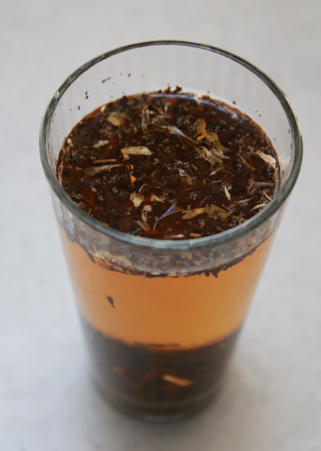
The designed experiment gave us a way to make crowd-pleasing iced tea. (Photos courtesy of Caroll Co)
In my previous post, I described an experiment that my wife and I conducted to find a method for making delicious iced tea with juice. The factors we looked at were these:
Tea type: black tea or oolong
Steep method: hot water vs. cold water
Steep time: short (5 minutes hot/4 hours cold) or long (10 minutes hot/8 hours cold)
Amount of tea: 2 tsp per cup or 3 tsp per cup
Juice: cranberry or apple
Juice proportion: 25% or 50%
Added sugar: 1 tsp or 2 tsp per cup of liquid
So, were we able to make some great-tasting iced tea? Fortunately, yes.
However, in doing the analysis, I realized that I should have been more careful in setting up the design. For those who don’t care to read all the details below, I'll tell you what our experiment suggested worked best: Half apple juice with oolong tea was the best combination, with the cold steep method potentially being better.
Performing the Experiment
While the kitchen did become a bit cluttered, we were able to complete the experiment. I randomized the numbers on the cups so my wife couldn’t easily associate batches of tea, and using the measuring tape for the response was effective.
The Analysis
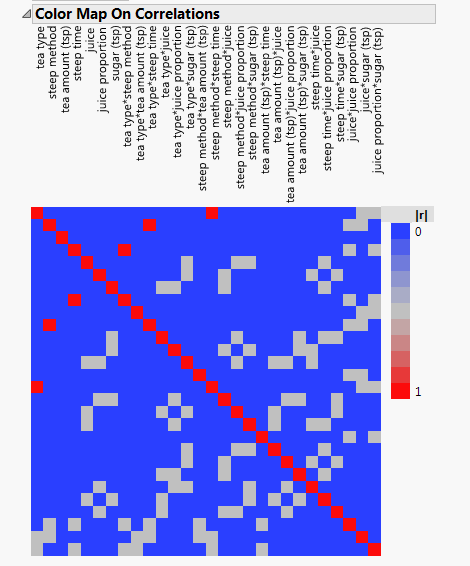
If you recall the design setup, I only specified a main effects model to the Custom Designer. Looking at the color map on correlations, the design is orthogonal for the main effects, so I can estimate them independently… but I have some full aliasing between main effects in the whole plot and two-factor interactions from the whole plot.
The one that concerned me the most is tea type being confounded with steep method * steep time. The steep time is really just a placeholder that depends on the method, so in hindsight I would have included this interaction in the model – I guess that’s what follow-up experimentation is for, although I didn’t have that luxury this time.
Fitting the main effects model, I see that apple juice and using more of it show up as significant. I also noticed that oolong tea and cold steeping have larger effects.
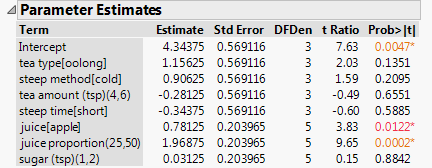
After doing some model exploration, I see that a much simpler model comes from using tea, juice and juice proportion:

It is interesting to note the juice*juice proportion interaction, since it was partially aliased with steep method in the original design. With the interaction in the model, the effect of steep method becomes rather small. We’ll still investigate steep method if/when we do some more experiments, but the fact that both main effects from the interaction are significant suggests the larger effect in the main effects model was mostly due to the interaction.
Final Thoughts
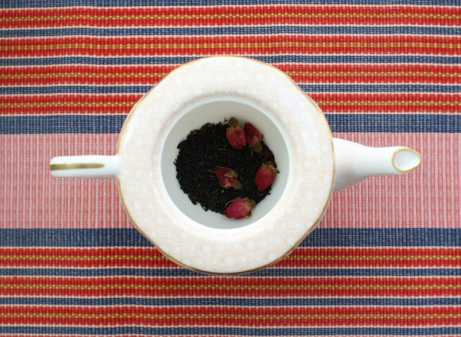
I would have been more careful with the design if we had had more time. But we still got useful results.
If I wasn't pressed for time, I would have been more careful with the design that we ran, either by adjusting the number of whole plots or ensuring the confounding happened between two-factor interactions. However, it was still better than no experiment at all, since we had no idea whether we would even be able to come up with an iced tea to consider serving, so the results were pleasantly surprising.
We did cold steep oolong tea overnight and then used the 50% apple juice proportion. Based on the results, we also used less tea and sugar than we might have otherwise, since they didn’t have a large effect. We went through 2 gallons for 10 people, with other drink options (including apple juice all by itself), so it must not have tasted all that bad.
Any future kitchen experiments you would like to see? Leave a comment below and let me know. Thanks for reading!

