One of the great new pleasures in life, if you enjoy crunchy chocolate, is pretzel M&Ms. If you haven’t tried then yet, you should!
I’m down to my last five – one of each color (red, blue, brown, green and orange.) Should I eat just a couple and save the others for later, or eat them all one at a time?
This gets me thinking of all of the possible ways I can eat the M&Ms. If I eat just two, which colors should I choose? Do I start with the red and then eat the blue? What if I close my eyes and randomly select the two M&Ms? How many possible choices can I make?
Thinking back to the days when I took undergraduate probability and statistics, I recall the discussion of combinations and permutations. If I select two candies and order doesn’t matter, then I’m interested in the number of combinations. In other words, selecting a red first and then a blue counts the same as selecting a blue and then a red – it's still just one combination.
However, if I select two candies (without replacement) and order is important, then that’s a permutation. So, selecting a red first and then a blue is one outcome, and selecting a blue and then a red is another outcome.
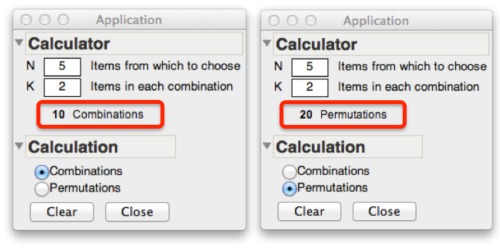
Good thing Mark Bailey, a JMP education specialist, has written an application to do the math for us. It turns out we have a lot of choices! There are 10 possible pairs of M&Ms I can select from the five. And, if I’m interested in order, there are 20 possible outcomes, or permutations.
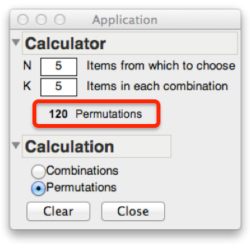
What if I can’t resist and decide to eat all five? How many combinations and permutations are there? There is just one combination, since all five will be eaten. But, there are 120 permutations – 120 possible orders in which I can enjoy eating my last five M&Ms!
Hmm, I’m getting hungry!
The Combinations and Permutations application is available as an add-in on the JMP File Exchange (requires a SAS profile to download) or from the Academic Resources page.


