This year, Chinese New Year arrives on Feb. 19. From what I can remember, this is quite late. But how late is it exactly? I was curious to find out, so I turned to the Internet and found a website that has collected Chinese New Year information since 1900.
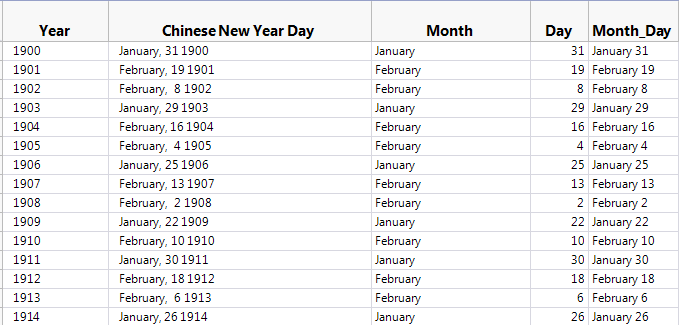
I used Internet Open to import the data into JMP, and then used Date Time functions in Formula to create the columns, Month and Month_Day, for my analysis. This is what my Chinese New Year data from 1900 to 2015 looks like:
After that, my analysis is straightforward and is as easy as a cup of Oolong tea.
The earliest Chinese New Year’s Day arrived on Jan. 21, 1966. The two latest arrivals occurred on Feb. 20 in 1920 and 1985. In the last 116 years, the Chinese New Year has arrived within a span of one month, from Jan. 21 to Feb. 20The mode is Jan. 31; on this day, the Chinese New Year was celebrated six times. Six other dates shared the No. 2 spot: Jan. 23, Feb. 2, Feb. 5, Feb. 6, Feb. 10 and Feb. 13. Roughly speaking, the odds of celebrating Chinese New Year in February instead of January is 2:1.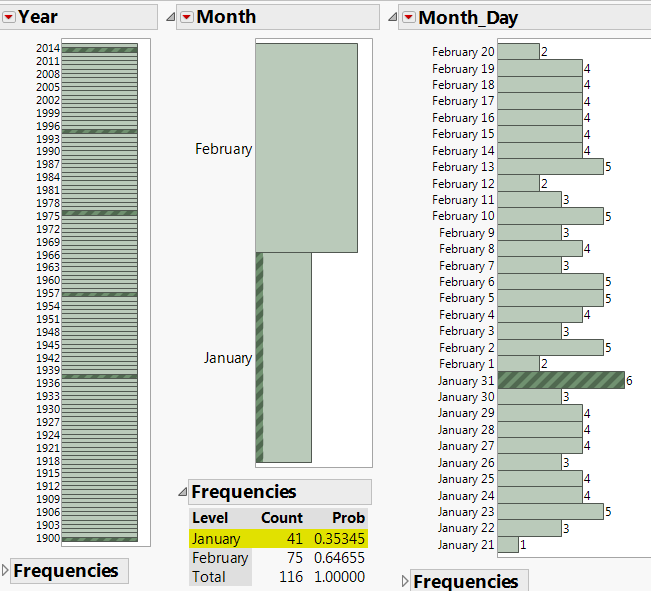
The sampling distribution of Chinese New Year is neither normal nor uniform. So, while this year’s Chinese New Year may not be latest, it is the latest since 1996. And this year, it looks like this:
Happy Year of the Sheep! (Image used courtesy of Art of Pic.)
We wish you all a Happy Chinese New Year!
